Data-centre connection requests reported by the IESO — up about 70% in two months. Hydro Ottawa separately reported 34 large projects in its queue, together worth roughly 86% of the utility’s average load.

Power that doesn’t
wait for the grid.
One provider for the whole site: generation, storage, controls and charging behind the meter. PolarLit 1 on the public and fleet bays, NorthernLit 1 at home and at work, Community Power Hub where one panel has to serve a whole lot.
One provider,
the whole stack
Most vendors sell a box and leave the joining-up to you. We take the site as the unit, and stay responsible for all six layers of it.
Twelve months of interval data, the peak demand line, and the connection date you were quoted.
Modular blocks on your side of the meter, sized to the load rather than to a catalogue.
A battery buffer that absorbs step loads, so generation runs near its efficient point.
Switchgear and load management that cap grid draw and decide when to generate, charge or shed.
PolarLit 1 for public and fleet bays, NorthernLit 1 for homes and workplaces, Community Power Hub for shared lots.
Monitoring, fuel, scheduled maintenance, and a monthly report of the peak that did not happen.
What is stopping you
is the connection date
Not the price of power. It is how long it takes to be allowed to draw more of it — in most of Canada, years.
More than 20,600 MW of data-center load has been requested from the AESO, against a provincial peak of roughly 13,000 MW. The interim allocation for new large load through 2028 is about 1,200 MW — and it is fully spoken for.
Alberta’s Data Centre Regulation (AR 117/2026) now codifies a “bring your own generation” approach, giving projects that tether their own supply priority over those that do not. The policy is telling large loads to supply themselves.
Waiting for the utility
Application, capacity study, connection agreement, construction, transformer. The queue decides the date — and one peak month resets your charges every month.
Building it on your side of the meter
Sized to your load profile and delivered as modules. Manufacturing and permits set the schedule, not a queue. The grid stays backup.
Four parts,
one controller
Generators are a commodity. What decides whether a site saves money is the layer that knows when to run them.
01 — Generation
Modular blocks
Containerised or trailer-mounted, sized to the load. Natural gas primary, CNG/LNG/RNG where the fuel path allows, black-start capable.
02 — Storage
The shock absorber
A battery buffer absorbs step loads, so generation runs near its efficient point.
03 — Controls
Where the money is
Measures demand in real time, caps grid draw, decides when to generate, charge or shed. Without it, a generator is an expensive backup.
04 — Charging
Loads that behave
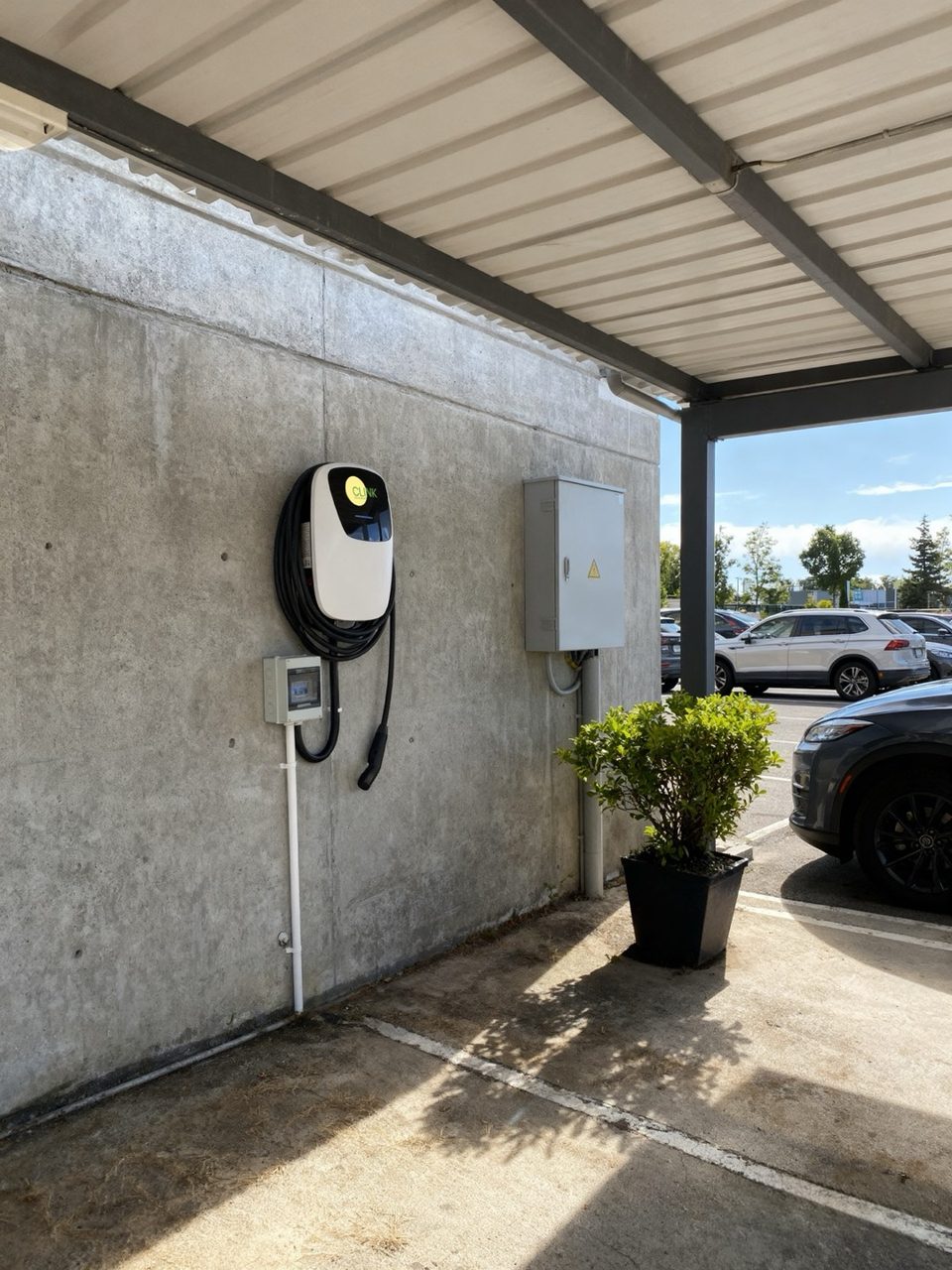
Vehicles? The chargers join the same controller — PolarLit 1 on the public and fleet bays, NorthernLit 1 at home and at work. NorthernLit 1 speaks OCPP 1.6J, so charging follows the site peak.
Two chargers,
two jobs
Public and fleet bays take PolarLit 1. Homes, workplaces and shared lots take NorthernLit 1. Both sit on the same controller as the rest of the site.
Commercial & public
PolarLit 1
Pillar charger for sites where the driver does not own the meter: public bays, fleet yards, workplaces and main streets. Pedestal form factor, silver-white body with a vertical yellow panel down the right side.
- OutputTo be published
- ConnectorsTo be published
- CertificationTo be published
- NetworkTo be published
- WarrantyTo be published
- PriceTo be published
PolarLit 1 numbers go here once the data sheet is verified. Ask us for the current revision before you specify a site.
Home & workplace
NorthernLit 1
Level 2 charging for driveways, workplaces and shared lots. 12 kW hardwired or 9.6 kW on a NEMA 14-50, J1772 or NACS, 7.6 m cable, three-year warranty and OCPP 1.6J. UL Listed.
- Output12 kW hardwired · 9.6 kW plug
- ConnectorsJ1772 or NACS
- CertificationUL Listed
- NetworkOCPP 1.6J
- Warranty3 years
- PriceCA$1,199
Sites where the grid
is the wrong answer
We do not sell this to everyone. It earns its place when the grid is slow, expensive to expand, or not there.
Fleet depots & logistics
The window is fixed
Vehicles return evening, leave morning. That concentration sets a demand peak the utility may not serve for years.
Manufacturing
Shave the peak
On a demand-billed account, the month’s worst fifteen minutes can dominate the bill. Trimming that peak beats cutting consumption.
Charging hubs
Fast charging, slow approvals
A fast-charging site needs a connection a queue may never deliver. On-site supply decouples the two.
Remote & resource
Beyond the line
Communities, mines and camps on diesel. Delivered LNG or CNG displaces the fuel that costs most to move.
Construction & events
Bridging power
Power that arrives before permanent service, then leaves. Rent capacity for the job instead of building a connection you abandon.
Data & critical loads
Bridge, then stay
Energise on your own supply while the connection builds, then keep it as backup — what Alberta’s new rules reward.
Agriculture
Heat where it is made
Greenhouses and grain drying want heat as much as power. CHP turns one fuel bill into both.
Stop buying the
wrong kilowatt
On a demand-billed account the line that hurts is kilowatts, not kilowatt-hours. Put your own numbers in — the rates are editable.
Defaults come from Hydro One’s published 2026 General Service demand example, where the distribution volumetric demand rate is $22.5201 per kW and the retail transmission network and connection rates add $3.1662 and $2.4073 per kW in the same worked example. Your rates are on your bill — overwrite them. This is arithmetic, not a quote, and it excludes commodity, Global Adjustment and everything else that is not a demand charge.
One hundred kilowatts of peak at those rates is about $2,800 a month of demand charges. Cutting forty is worth roughly $13,700 a year — before a single kWh is generated.
Alectra’s Ultra-Low Overnight prices on-peak at 39.1¢/kWh and overnight at 3.9¢/kWh — roughly ten to one. That window is where the rest of the value sits.
A saving we have not modelled against your interval data. On-site generation has a real cost per kWh — if the grid is cheaper for your profile, we will say so.
Specified backwards,
from the site
We keep no catalogue of generators. We start from what your site does, write the spec, and hold manufacturers to it.
Read the bill and the load
Twelve months of interval data, the peak demand line, the connection date you were quoted.
Write the spec from the scene
Required kW and kWh, run hours, noise limits, emissions envelope, mobility, winter.
Reverse-engineer the hardware
We take that spec to manufacturers and hold them to it. The value is knowing what to demand, not buying boxes.
Deliver and certify
NRTL certification, interconnection, permits, plus the noise and air approvals that decide if the site can run.
Operate and report
Remote monitoring, fuel, scheduled maintenance, and a monthly report of the peak that did not happen.
You own it; we engineer, deliver, commission, then maintain under contract.
Capacity for a defined term, off your balance sheet.
Temporary supply while the permanent connection builds.
Energy, not equipment. We carry the capex and the risk.
Where the load is public charging, we take our return from utilization.
What we can prove,
and what we can’t
A young line of business. Here is the boundary, honestly stated.
Certification path
Certifiable in Canada before it is worth discussing. The list is not optional:
- EV supply equipment — CAN/CSA-C22.2 No. 280, aligned with UL 2594
- DC fast charging — CSA C22.2 No. 340 / UL 2202
- Generator sets — UL 2200, to the authority having jurisdiction
- Parallel operation — IEEE 1547 and the utility’s own interconnection process
- Outdoor equipment — IP54 or better, with cold-weather start packages
- Connectors — NEMA, J1772 or CCS as the application requires
The limits, stated plainly
We would rather lose a month than win a signature on a promise we cannot keep:
- Fuel is the hard prerequisite. No pipeline and no delivered CNG or LNG route means this is the wrong solution, and we will say so on the first call.
- Gas is not renewable. RNG blending is a path, not a claim. We will not dress this up as clean power.
- Permits are local. Air, noise and utility approvals are decided by your municipality and your utility, on their timeline.
- We are not a utility. Exporting or reselling electricity depends entirely on the rules in your province.
- First deployments are being scoped. If a configuration is still being engineered rather than proven, you will hear that before you sign anything.
Do you sell electricity?
No. We operate behind your meter. Whether surplus can be exported depends on your utility and province — we will not assume it in a business case.
Does every site need a gas connection?
For gas generation, yes — a pipeline service or a delivered CNG/LNG supply chain. Where neither exists, we will tell you early rather than sell you around it. All-electric configurations with storage-only peak shaving are a separate conversation.
Does it run in a Canadian winter?
It has to. Cold-weather packages, enclosure ratings and black-start capability are part of the specification we write, not optional extras — and the commissioning plan includes a cold start, not just a warm one.
How fast is “fast”?
Slower than a brochure and faster than a connection queue. Once a site is surveyed and permitted, the schedule is driven by manufacturing and delivery, not by an interconnection study. We will give you a real date after step 01, not before it.
- Hydro One — Your bill, explained (2026 rates, General Service demand example)$22.5201/kW distribution demand, transmission demand rates
- Alectra Utilities — electricity prices (ULO, Nov 2025 – Oct 2026)39.1¢ on-peak vs 3.9¢ ultra-low overnight
- The Globe and Mail — data centres lead to a surge in grid requestsIESO ~6,000 MW; Hydro Ottawa 34 projects
- Bennett Jones — Data Centre West 2026 (AESO queue, AR 117/2026)>20,600 MW requested, 1,200 MW interim allocation
Send three things
Twelve months of electricity bills — or just the peak demand line. The load you want to add. The date you need it by. That is enough for us to tell you whether this is worth pursuing, and we will tell you when it is not.
Prefer to talk it through first? Book a call — we will ask about your bill before we say anything about our equipment.